A few weeks ago, Ben Goldacre wrote, "If you do not link to primary sources, you are dead to me."
Seems fair enough to me. So this blog post provides some of the evidence and some of the links to primary sources for my TV programme “23 Week Babies: The Price of Life”, broadcast on BBC2 at 9pm on March 9th 2011. A 2 minute trail is here.
My view is that there are better places than television for all the facts and figures that surround the kinds of programme I make. So this document is for the nerds and geeks and anyone else who’s interested in the numbers. And for anyone who wants to hold me accountable.
Feel free to email me, or add comments. I hoping that if there are errors they aren't too terrible.
Please do join in the debate about the programme:
Twitter: #23weekbabies
Adam Wishart
9 March 2011
Twitter: @adamswishart
Website: www.adamwishart.info
Facebook: www.facebook.com/adamwishart
Email: adam (at) adamwishart.info
CLAIM ONE: Chances of survival for 23 Weekers
For babies born in the 23rd week, survival odds are as follows:
- 91 out of 100 babies die in hospital in the first weeks of life.
- 9 out of 100 babies leave hospital.
Of those 9:
- 2 are severely disabled
- 4 are moderately disabled
- 2 have some impairment
- 1 survives unscathed.
How do we know this? The best research on the outcomes for extremely premature babies is the EPICURE study from the Nuffield Council of Bioethics Report, “Critical Care Decisions in fetal and neonatal medicine: ethical issues”. (2006) The researchers studied all the premature babies born during ten months in 1995 (1185 babies in total) and then followed up when they were two, six, and ten years of age.
This is the key table, from page 71 of the report.
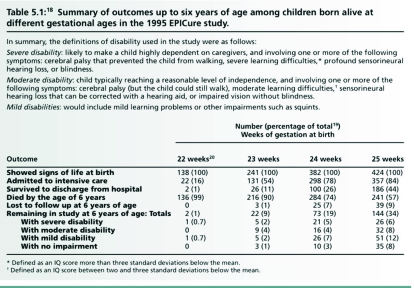
Surely, you might say, this evidence is out of date: the babies were first surveyed more than 16 years ago and, what with the general advancement of science, things must have moved on. If I may, I'll come back to the discussion of this point at the end of these notes, after looking at some of the other claims in the film.
CLAIM TWO: Rates of survival
Another key claim in the film is that, in the words of Imogen Morgan the Clinical Director of the neonatal ward at the Birmingham’s Women’s Hospital, “The proportion of 23 week babies surviving isn't increasing… We are close to a limit of nature.”
I also say that whilst there has been little improvement for babies born in the 23rd week, there has been significant improvement in babies born in the 24th week and above.
The key paper for this proposition is from a series of studies from the Trent region of the UK : "Survival of extremely premature babies in a geographically defined population: prospective cohort study of 1994-199 compared with 2000-5."
Here they studied all the babies born in one geographical region, Trent*. They compared the outcomes for babies born between 1994-1999 and those born between 2000-2005.
What did they discover? "Survival of infants born at 24 and 25 weeks of gestation has significantly increased. Although over half the cohort of infants born at 23 weeks was admitted to neonatal intensive care, there was no improvement in survival at this gestation."
But, I hear you ask, that only takes us to 2005, which is 6 years ago. Bear with me, please.
* It’s better to look at these so-called cohorts because there is less bias than if you looked at, say, just one hospital which might be significantly better or worse than others.
CLAIM THREE: Number of 23 weekers born
The film says that “a few hundred” babies are born in the 23 week of pregnancy each year. This is an estimate of the right order of magnitude, extrapolating from the fact that there were a total of 110 babies born at 23 weeks in most, but not all, neonatal units in England (from the Neonatal Data Analysis Unit: Neonatal Specialist Care in England: Report on Mortality in 2009). As the figures don’t include every single English unit – and nor do they include any units in Wales, Scotland and Northern Ireland – I extrapolated to “a few hundred”. A bit woolly, but the best we could do with the available data.
CLAIM FOUR: Cost to the NHS
The film says that the NHS spends about £10 million a year on these babies.
This is a simple calculation from these facts:
- One night for one baby in a neonatal intensive care costs around £1000 in terms of equipment, staff, overheads and so on.
- On average, these babies stay in hospital for about 35 days
- Say there are approximately 300 hundred babies per year
The estimate for the cost of baby Matilda, who goes home after 139 days is about £150,000.
The cost is rising: according to the commissioners in the West Midlands the total cost for neonatal services in that area rose by 10% last year. Whether that is the whole of the trend or a blip is more difficult to calculate.
Other considerations:
- Within the total NHS budget of about £100 billion, the figure of £10 million is pretty insignificant.
- As 8 out of 9 of the surviving babies will be disabled, they will continue to cost the NHS throughout their lives, so these figures are just the start of the cost of these babies to the NHS.
- As Heather Rutherford explains in the film, the care these people receive is greatly reduced once they hit the age of 18
- In the film, I ask Ann Aukett, a community paediatric who looks after survivors, if she is able to give the survivors the care they need, and she categorically says no. Whilst making the film, I met a 23 week baby who was two years old and who had had to wait a whole year for a physiotherapy appointment. Which suggests to me that we are not caring for these babies properly once they leave hospital, even before they are 18.
- I also saw a baby who was most likely born in the 22 week (often it is not possible to date conception exactly), but had been resuscitated despite the guidelines. So as a nation we spent a few thousand pounds keeping a baby alive that would almost inevitably die, and yet we couldn't provide simple therapy for a child that modern medicine had allowed to survive, but disabled.
CLAIM FIVE: Britain amongst worst premature birth rates in Europe
The European Perinatal Health Report collected data from across Europe in 2004 and published it in 2008. The data for premature births under 32 weeks is on page 131. (Below 32 weeks, of course, isn't the same as 23 weeks but the data is not available for 23-weeks and choosing the later range does mean that the numbers are quite large, and therefore more accurate. As the numbers of below 32 weekers goes up, then so does the absolute number of 23 weekers.)
Percentage of babies born prematurely at 32-weeks or less, by country:
- England and Wales, Hungary, Austria = 1.4% [Highest percentage]
- Germany = 1.3%
- Denmark = 1.1%
- Italy, Ireland, = 1%
- Sweden, France, Greece, Finland = 0.9%
- Spain = 0.8%
- Malta = 0.7%
In other words, Britain has about fifty per cent more babies born (per capita) in prematurity than some other European countries.
CLAIM SIX: Link between premature births and deprivation
The epidemiologists state the evidence the best: "the incidence of very preterm birth is nearly twice as high in the most deprived areas compared to the least deprived areas" (Socioeconomic inequalities in survival and provision of neonatal care: population based study of very preterm infants.)
But it seems very difficult to discover why it is that people in deprivation have higher incidence of preterm birth. Many reasons are being studied – including smoking, alcohol and non-attendance of pre-natal check-ups - but the answer is not yet clear.
CLAIM SEVEN: Intervention levels increasing, but survival rates not
Towards the end of the film, neonatal consultant Anne Aukett explains that 23 week babies are enduring more and more medical intervention. How do we know this?
Going back to the Trent Study mentioned in Claim 2 above, looking at the table on the second page, it says that between 1994-1999 the average time that 23 week babies spent on the ward was 22.9 days. And then between 2000-2005 that number had gone up to 34 days. So babies now spend nearly an extra two weeks on the ward, during which time they have a variety of medical interventions – often including ventilators down their throats and needles into their arms - which cause some pain and discomfort.
These extra two weeks of pain have failed to provide any benefit according to the Trent Study.
A different cohort published last year came to similar conclusions. “Survival in infants live born at less than 24 weeks’ gestation: the hidden morbidity of non-survivors” concludes that "Over the last 15 years, increasing numbers of babies at less than 24 weeks have received active resuscitation. Overall survival has not changed, but non survivors have endured significantly longer durations of intensive care." This includes data up to 2007.
CLAIM EIGHT: Outcomes not improving over last 15 years
Throughout the film – and these notes - there is the tacit idea that the evidence as outlined above gleened from reports over the last 15 years remains true. But perhaps the outcomes have radically changed in the last couple years. Perhaps there is some unpublished data which suggests that there is a radical new treatment that is prolonging the lives of 23 week babies.
The first thing to note is that these studies are really the best evidence we have. In all these cohort studies there is very limited data from this year or last year. Part of the trouble is that it takes time, years, to collect and assess the data. Frankly these studies much be a bureaucratic nightmare: just imagine trying to follow a couple of thousand people for years, when we all lead such transient lives.
Another problem is that to really understand the outcomes we have to wait for children to grow up. The cohort of the EPICURE study is now only 16 years old. And, as with all of our lives, long term outcomes is vitally important.
But just to check that there were no new studies that would radically change our view, I phoned Elizabeth Draper, the professor of perinatal and paediatric epidemiology at Leicester University. She is the lead statistician on both the big cohorts in the UK, EPICURE and Trent. They continue to collect data. I asked her whether there was any evidence that survival rates for 23 week babies have increased in the last few years. Her reply was that there wasn't any statistically significant evidence.
The real problem is that the numbers of 23 week babies is so small it is difficult to create a powerful enough study to reveal it.
CLAIM NINE: Other countries have better survival rates?
Well in fact this isn’t my claim. But it is often mooted on the radio and on discussion boards. People claim that the outcomes for Sweden or America are much better. If only Britain would do more doctoring then everything would be okay.
Here is one of the studies that is sometimes referred to. One-Year Survival of Extremely Preterm Infants After Active Perinatal Care in Sweden.
This suggests that Swedish neonates have much better survival rates that in the UK. About 10% of 22 weekers survive, and about 50% of 23 weekers survive.
I spoke to one of the authors, Professor Karal Marsal, about why this might be. Simply, he wasn’t sure. It might that the Swedes have different protocols on delivery, they might be more interventional in the delivery room. This is mentioned in the paper. But certainly another reason was the ‘background population’.
Britain simply has a very different group of mothers giving birth to these neonatal babies than the Swedes. He said they have basically almost no teenage mothers, and yet that is one of the groups prone to preterm labour in the UK is just this one. And we have high rates of teenager motherhood. Also if you look at the Eurostat data cited above, about 17 per cent of British mothers smoke during pregnancy, whilst less than half that percentage in Sweden. Similarly, 91 per cent of Swedish women visit their doctor during the first trimester of pregnancy whereas only 65 per cent of British women do.
It seems likely that if you have a more health aware and more active cohort of mothers, who give birth at much lower rates of prematurity, then the health of their offspring is also likely to be better. And therefore the survival of neonates born in extreme prematurity would be better.
Professor Liz Draper also told me that comparing cohorts between countries is also very difficult. Sometimes it is difficult to compare like with like.


Hello
Our third child, Lucas, was born at 24 weeks in 2009 and doing beautifully. My husband is Dutch and at the time Lucas was born we were told that Dutch hospitals do not resuscitate below 26 weeks - I'd be interested if you can confirm this.
My main question, after watching your excellent documentary, is how is Mathilda doing now? (Assuming some time has passed since you finished making the programme.)
Thank you
Posted by: Elizabeth de Jong | 09 March 2011 at 11:36 PM
@elizabeth the dutch guideline for treating very premature babies changed just last autumn. Doctors are now actively treating 24 week old babies (not 23 week old babies though), although they strongly feel they should not do anything that's technically possuble. In the previous guideline, active trwatments of 25 week olds was propagated under the same reservations. From what I learned from my own gynaecologists when I was pregnant myself (in 2007 and 2010) I know that in reality, most doctors chose only to treat 25 week olds if they were strong enough to breath on their own at least for a couple of hours after birth. The same now goes for 24 week old babies. That means that if your son had to be resuscitated at birth, in the Netherlands he probably wouln't have survived.
More about the new guideline (in dutch):
http://medischcontact.artsennet.nl/Tijdschriftartikel/Leven-met-24-weken.htm
Asha ten Broeke
(science writer and mother, from the Netherlands)
Posted by: Asha | 10 March 2011 at 11:12 AM
Dear Adam
You need to know about Angelo Volandes in Boston. He is working in this area as well.
Glyn Elwyn
avolandes@post.harvard.edu
http://www.ethics.harvard.edu/people/show-bio/all/256?layout=showbio
Posted by: Glyn Elwyn | 10 March 2011 at 12:57 PM
Dear Adam,
The use of primary material such as the above linked studies was not directly obvious in the documentary and I am pleased to you know that you did use accurate source material. However, I would like to know how you can further justify the use of the 9/100 figure.
On its own, this figure seems to be true but it includes the deaths in the delivery room. As the documentary makes the point of cost of care multiple times, of the suffering and the prolonging of agony that people cannot really understand unless they have been there, then it should only apply to the babies that are admitted to neonatal care / NICU. The EPICure 1 study claims that only 39% of the birth showed signs of life at 23 weeks and, of those, 50% died in the delivery room. Of the babies admitted to NICU, ~20% survive at 23 weeks.
Can you please explain why you chose to use the 9/100 figure, when the 20/100 figure (1/5) is the accurate one for the views that were expressed?
Thank you!
Posted by: Charles | 10 March 2011 at 01:58 PM
Charles,
As you say, the data clearly states that 9 out of 100 babies born at 23 weeks survive long term (greater than 6 years). Although you would like those babies who die in the delivery room to not be included in this depressing statistic, I don't think that would be very wise.
I believe it is important to consider what the baby born at 23 weeks goes through in the delivery room. Resuscitation-which is a horrendous experience- happens in the delivery room. Only stable intubated babies would make it to the NICU. Those babies who do not survive resuscitation still deserve to be included in the total statistics.
Posted by: pin | 10 March 2011 at 04:56 PM
Dear Adam
Thank you for giving us your sources: they are somewhat out of date and don't precisely give the correct prognosis. It would have been helpful to have perhaps discussed these issues before moving on to repeatedly reiterate them during the programme. As neonatologists we have to deal in these data everyday and how they are presented and interpreted will drive the discussion. It also doesn't help to describe attempts to stabilise babies in such emotive terms.
Bill Silverman prefaced an article about our early report with the quotation "is the glass half empty or half full – it depends whether you are drinking or pouring". It seems you have taken up one stance. It doesn't help to quote data from areas where many of the babies were not actively intervened with (in Charles' response above).
It is true that in 1995 we reported as you quote but we need to ascertain which babies had active intervention which was not really available in the EPICure study and the 1 in 100 statistic misinterprets mild disability – which refers to minor visual impairments and mildly depressed developmental scores which I don't think we should be using as reasons for writing off children. The key statistic is of those babies admitted to NICU of whom 6 in 100 survive without serious disability.
When we went back in 2006 we found no significant increase in survival, but survival had increased to 20% (see our website), we know that active intervention only occurred in about 85% and we know that survival is much higher in large perinatal units (by over 80%) - making your pessimistic assessment somewhat out of date. These data have been presented widely to professional groups. This reflects the fact that intervention is much more likely at this gestation whereas in 1995 it was much less likely to occur.
I cant give you chapter and verse on outcomes as we are still analysing those data but at 3 years it doesn't look as if the outcome is any worse for survivors. The hospital based outcomes for my present hospital were published a couple of years ago showing close to survival rates reported by the Swedes in the Express Study which would fit with increased survival at level 3 Neonatal Intensive care Units (given the imprecision of small numbers from one hospital). Clearly if 1-in-5 is surviving without serious disability (as seems to be happening in some centres) then your report is completely inaccurate in this area. The factors which influence outcome will very much depend upon the surroundings in which the child was born; we use the 1 in 100 statistic to refer to babies at 22 weeks, and will not intervene unless pushed very hard as I agree totally with the documentary that this would be unacceptable.
The points you make about family support and support for adults were however very well made and I can support whole heartedly; if we are to improve the outcomes at the advancing edge of gestations at which survival is increasing then such support is mandatory and it is a scandal that it does not occur! Of course very many more children have disability from conditions other than prematurity and find it equally hard to access services - that is a much more relavant statistic, a national shame and scandal, than for the very few sub 24 week babies that have problems.
The challenge for modern medicine is to reduce the impairment rate by understanding which factors lead to them and intervening to stop them. That the Dutch would not have bowed to pressure and changed their policy if we were not doing this, is somewhat more relevant than the fact they wont resuscitate at 23 weeks, than was given credit for.
I think as society we still have to get this area right. In the 80's it was babies <1000g birthweight, in the 90's it was babies born at 24 weeks, now it is babies born at 23 weeks. Drawing a line in the sand is truly difficult for doctors and parents alike and we must make individual decisions as to what is in the child's and the families' best interest. This involves difficult conversations that your programme has highlighted appropriately, even in if based on the bleakest of prognoses from the mid-1990's.
Posted by: Neil Marlow | 10 March 2011 at 06:51 PM
Dear Adam,
Many thanks for your explanation. I have to disagree with your conclusion concerning the delivery room. My son was born at extreme prematurity and resuscitated. I witnessed him being intubated. I would say this is the very least that you would expect for anyone to try and save their life and I agree with Neil that you are describing it far too emotively. Regardless, from the 1995 data - 39% of babies born at that gestation show no signs of life at birth and, as we were informed quite clearly, there would no attempt at resuscitation. This still means that your figures are 39% too high (9/61) and should be closer to 15% survivors from the 1995 data. Adding to this the information from Neil concerning the Epicure 2 data your data is clearly out of date and the figure may even exceed 20%.
As I have been one of the parents who was told the survival chance of their son before birth was bleak and that they would not resuscitate if there was no sign of life, I am thankful that I was given the correct statistics by the neonatologists at the time. As your figure has been published widely, the few who are in the unlucky position to have 23 week old preterm births will have it at the back of their minds, affecting that experience and potentially their decisions.
Will you do anything to correct this misunderstanding or do you still believe that your figure is correct?
Posted by: Charles | 11 March 2011 at 10:23 AM
The statistic that only ..... 1:9 of those that survive are able bodied, thereby 8 have disablement put upon them, therefore suffering, is appalling. It is doctors playing God because we have the ability to put a tube down and attach to a respirator. With these statistics coldly before them they must respond as a caring human and that is to not force on this preterm baby pain, operations, difference to others and particularly when it known that 'difference' in a child causes family breakdowns and when it known that most 23 weekers are born in UK to low socio-economic mothers this is compounding poor reasoning for forcing survival. Also now research has told us - babies treated in SCBU have a lower pain threshold than the 'norm' because they are overly sensitised to pain by the care/treatments required for medicine in such a Unit. If the newborn cannot breathe spontaneously then leave for nature to reclaim. Ours is not to overpower or disregard nature.
The other part of this whole for the Health Service is the monetary cost. If people want the baby maintained artificially then they should contribute to the costs after the first 10 days and so on when further care required over the years due to poor formation of the person due to imbalance of gases or generation of the body outside of the mother. This is the same emotive quandary as presented by hyper-expensive cancer drugs - should 1 person's care that is only putting off the inevitable take the money that would treat 50 patients that will recover. If a person wants that few more weeks then pay. If the drunks littering A&Es every w/e were told to pay for their care then they might act more responsibly for their futures and not be the future statistic in the liver disease Wards at great cost. At present we have in UK a very UNegalitarian health service because of misguided sympathy also misuse by many and we are all the losers.
If less people misused it then there would be more money and time to assist and advise 'at risk' pregnancies and fewer 23 weekers to be part of these disturbing statistics.
Posted by: Sadie Mumford | 16 March 2011 at 11:51 PM
Dear Adam,
I am the mother of a baby boy born nearly two years ago in the U.S. at 23 weeks 0 days, weighing 645 grams and measuring 28 cm in length. We adopted him; his birth mom is family. Before Andrew was delivered in an emergency C-section due to his mother's severe hemorrhaging, the doctors told her the baby had a 50/50 chance to survive. They didn't tell her the odds were such only if he made it out of the delivery room; they meant those were his odds, period. This was a level III NICU (Ohio State University Medical Center in Columbus, OH). He was transferred at eight days of age to Nationwide Children's Hospital, a level IIIc NICU in the same city, when it became apparent that he had a large PDA that wouldn't close (the duct in the heart that normally will close with an infant's first cry). He had his PDA ligation there. That hospital has a 63 percent survival rate for 23-weekers presently, ever since they developed a program called the Small Baby Guidelines that they use for babies under 27 weeks. Granted, babies aren't born there, so their numbers should be higher than average. No delivery room statistics there to bring them down. And yet, 63 percent is a good rate, even without the delivery room numbers. 50 percent at the other hospital, for a boy, especially, at barely 23 weeks, sounds pretty good too. These are excellent hospitals, but there are many other hospitals in the U.S. that also regularly revive 23-weekers, and some, like the ones Andrew was at, also resuscitate 22-weekers. Sadly, most of the 22-weekers do not pull through, but I did meet one smiling toddler born at 22 weeks 5 days who was running around at our NICU reunion last year. It's true that the majority of babies born at 22 and 23 weeks may have some delays, but that isn't so in all cases.
Just this month, Andrew was tested on the Bayley III Scales of Infant Development by our Early Intervention team. He tested in the normal range in every category for his actual age, when compared with full-term babies who will be 2 in April. For his adjusted, or "true" age, he was above the mean in everything, his highest score being receptive language, where he's in the 95th percentile. I give you that score because Andrew does have a disability--he suffers from moderate to moderately severe hearing loss, probably caused by the early antibiotics he needed. But he hears great with his hearing aids and has really benefited from his Early Intervention speech therapy and a language-rich environment at home. He loves books more than any toddler I have ever seen and sometimes brings us as many as 50 a day to read to him. At 19 months corrected, he knows 14 body parts, a handful of numbers, letters, and colors, and a few shapes and sight words. He has a wonderful attention span that everyone raves about, and is just the sweetest, happiest, "easiest" boy around. His therapists have told me they could stay all day with him, but luckily, I get to! :) He came home at 41 weeks on oxygen (for 4 months) but has had only 2 very mild colds in all his time home. He hasn't been on any meds since he was 4 weeks corrected. He's healthy, happy, and a great eater, too. Outcomes can be helped tremendously with the right kind of care, both in the NICU and afterwards. A baby's brain can rewire with therapy. Our speech therapist told us that a lot of the material they use for Early Intervention comes from the UK; she said your country is the leading edge of this kind of intervention, for which I am very grateful.
If you go to the National Institute of Health website, there is a calculator that can show you the odds for survival and disability for babies born at 22 to 25 weeks in the U.S. The data is based on a scientific study of outcomes at some of the better hospitals in the U.S. between 1998 and 2003. Even way back then, by plugging in some numbers, you can see that the chances of a 23-weeker making it was much better than the numbers cited in the film for how it is now in the UK. They included babies who died in the delivery room in that study. That is evident because they include outcomes for all babies vs. just those who were mechanically ventilated. Andrew's chance back then for survival without disability was 8 percent. But pretend he was a girl instead on the calculator and the chances for survival and survival without disability nearly double. Today, this calculator is outdated in some of our better hospitals, but it nonetheless shows you how far we've come in the last 10 years. Not all hospitals in this country will resuscitate a 23-weeker, mind you, but more are heading that way and beyond.
I am a member of an online preemie forum called Inspire, with members from around the world. We have had several regular posters from the UK. One mother's tragic tale centered on her son Oscar, born at 25 weeks. At birth they gave him very dismal odds of survival, which most of us on the board couldn't understand, because over here that is an age at which most babies can make it. In the end, he passed away. I think there is something to believing in the babies. If a hospital doesn't believe they can save a baby of a given age, then the outcome probably won't be very good. Andrew's doctors believed in him. His attending at Children's was the Chief of Neonatology there. He told me the day we took him home that he had been one of his sickest patients; he showed us one of his early X-rays and his most recent so we could see how much his lungs had improved. And he looked me in the eye and said he could go to any college in the country someday. I admit I was a bit skeptical at the time, for what I know of his heredity as well as the extreme prematurity (as one bio parent has an IQ more than one standard deviation below the mean). But my baby is testing above the mean now cognitively, and if he is at this young age, he likely will be on down the line too. Learning disabilities can creep up during the school years, no doubt, but he already has shown us he's a fast learner with a good memory, so we are hopeful things will work out just fine.
Nurture, whether in the hospital or at home, can make a world of difference. Andrew may have a disability, but he is clearly not disabled. Yet on most outcome surveys he'd be marked in the moderate disability column. A life not worth saving, full of suffering, it could be inferred from the film? Hardly. And, of course, even those with more severe disabilities can lead productive lives. Look at Helen Keller, who moved the world even though she had no sight or hearing. On our preemie board, some of the worst outcomes I've seen are for babies that were born at 26 weeks or higher, yet those children are and were (in the cases of those who didn't make it) the light of their parents' lives. So where do you draw the line, when you can have healthy 23-weekers and disabled 35-weekers? It's tough. I believe if the same debate started over here, it would center on 22-weekers, because their chances of survival are much less than 23-weekers, probably about the same as your 23-week UK stats that were given in the documentary. I understand that given such statistics, some might question whether it's worth trying to save babies so young. I just wonder why there is such disparity between our two countries' stats. And it isn't just the U.S....Australia, too, has good survival and outcome rates for 23-weekers, and I believe some other countries in Europe do as well. I think there's still room for improvement in all the countries mentioned. Maybe they can learn from one another, just as the U.S. has learned from the UK in the area of Early Intervention, which, like hospitals, can shape the future for these very early babies tremendously. Andrew's future is still undetermined, of course, but he's one baby I don't think anyone would bet against!
Posted by: Karen Meuller | 28 March 2011 at 08:37 AM
Link to the nih calculator for outcomes of micropreemies in the U.S.:
http://www.nichd.nih.gov/about/org/cdbpm/pp/prog_epbo/epbo_case.cfm
Posted by: Karen Meuller | 28 March 2011 at 08:59 AM
Dear Karen,
Thank you for your input. Adam used outdated statistics which are quite inaccurate as confirmed to me by experts in the field. The UK is not far behind the US, as Professor Marlow makes clear (he is working on the EPICURE 2 data from the UK). The effect of his program is most evident in the post by Sadie and is really most unfortunate for neonatal care in the UK, especially with the conditions of cuts to almost all services in the UK. My own experience of my son being in NICU in the UK was not like the programme and I cannot fault the people working there.
Posted by: Charles | 28 March 2011 at 12:36 PM
this post is awesome, expecting the neweset!!!Nice collections. You are looking very beautiful. I like these.
Interesting article. You have gained a new fan.I look forward to more of your cool blog posts.
Posted by: discount jordan shoes | 06 May 2011 at 10:24 AM